Webinars

Watch our on-demand webinars or join upcoming live events to learn how experts are using O-PTIR and multimodal techniques to gain deeper insights into the world around us.  

Webinars | Photothermal Spectroscopy Corp

Upcoming webinar

In this webinar, Assoc. Prof. Oxana Klementieva will present new findings based on her recent paper: Polystyrene nanoplastic exposure promotes amyloid misfolding and metabolic impairment at sublethal doses. A subcellular infrared imaging study.

Past Webinars

Explore our growing library of on-demand webinars covering cutting-edge applications of Optical Photothermal Infrared (O-PTIR) spectroscopy and multimodal imaging techniques. Whether you’re working in life sciences, microplastics analysis, environmental monitoring, or advanced materials research, our expert-led webinars offer practical insights, real-world case studies, and the latest scientific developments.

In this webinar, we’ll show how combining IR and Raman in one measurement improves confidence in material identification, reduces sample handling, and simplifies analysis, especially for heterogeneous and microscale samples.
Raman microscopy is widely used for chemical identification and chemical imaging, yet many real-world organic samples remain difficult to analyze with Raman. Biological tissues, cells, and environmental microplastic samples often exhibit strong fluorescence backgrounds, while weak scattering limits sensitivity. This webinar will discuss a breakthrough new sub-500nm IR spectroscopy technique called Optical photothermal IR spectroscopy (O-PTIR).
In this webinar, Dr. Kamilla Kochan (Monash University) will present work using submicron IR spectroscopy and imageing with Optical Photothermal Infrared (O-PTIR) spectroscopy to chemically identify individual microplastic particles inside intestinal epithelial cells while simultaneously monitoring cellular biochemical response. Submicron IR spectroscopy distinguishes polymers such as PE and PVC from biological long-chain aliphatics, linking verified particle presence and localization with
Discover how combining O-PTIR and SERS enables complementary biochemical imaging at the submicron scale for accurate, label-free cancer cell classification. Prof. Schultz will demonstrate how co-registered infrared and surface-enhanced Raman measurements reveal cellular heterogeneity and biochemical signatures that distinguish cancer cell subpopulations—overcoming traditional limits of IR diffraction and Raman sensitivity.
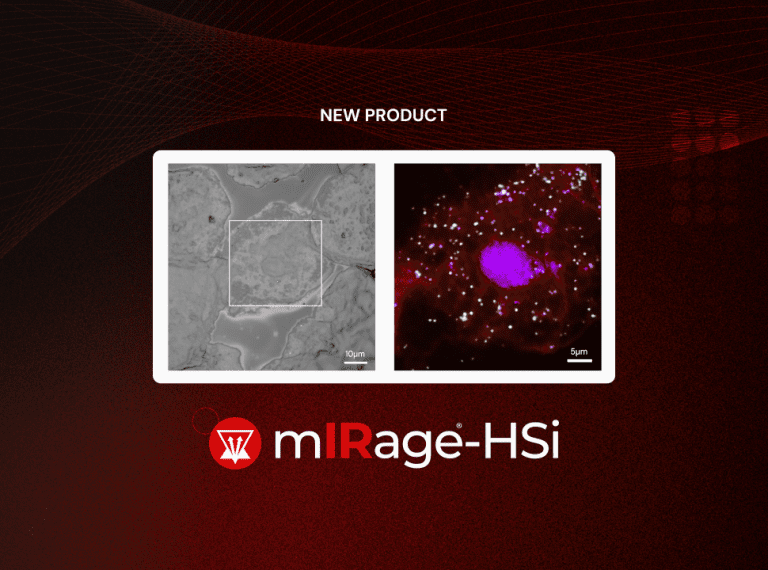
Meet mIRage-HSi, the next evolution of Optical Photothermal Infrared (O-PTIR) imaging, powered by laser-scanning optics for unmatched speed and productivity. Delivering FTIR transmission/ATR-like spectra at <500 nm spatial resolution, mIRage-HSi enables hyperspectral IR imaging in minutes and single-wavelength images in seconds — all in a non-contact, reflection-mode format with no spectral scattering artifacts.
Join Prof. Ji-Xin Cheng (Boston University), alongside our CTO Dr. Craig Prater in introducing stRAMos, our new high-speed imaging system powered by Photothermal Stimulated Raman Scattering (PT-SRS). With sub-300 nm resolution, ultrafast tuning, and live-cell compatibility, stRAMos delivers up to 10× higher sensitivity than conventional SRS—while supporting flexible formats from multi-well plates to thick tissues.
Discover how straightforward it is to chemically identify and characterize microplastics with submicron spatial resolution. Join Dr. Eoghan Dillon when he demonstrates the mIRage-LS O-PTIR live from our facility in Santa Barbara, California.
Why O-PTIR Is the Only Routine Tool for Accurate Particulate Characterization Below 10 Microns. Join us for a groundbreaking webinar on how optical photothermal infrared spectroscopy (O-PTIR)—with simultaneous Raman and co-located fluorescence—uniquely enables routine, label-free, high-resolution vibrational spectroscopy of submicron and even sub-500 nm particles.
Join Miriam Unger and Carolin Borbeck for a 1-hour interactive O-PTIR demo showcasing how multimodal IR, Raman, and co-located fluorescence microscopy identifies micro- and nano plastics with sub-micron spatial resolution.
In this exclusive webinar, Prof. Jürgen Popp and Dr. Christoph Krafft (Leibniz Institute of Photonic Technology) present groundbreaking work on submicron IR spectroscopy of leukocytes—performed directly on standard glass slides.
Please join Dr Markus Brandstetter, from Recendt in Linz, Austria, and Dr Mustafa Kansiz from PSC, in this two-part webinar to learn how submicron IR (O-PTIR) has been used to study microplastics (MPs) and even nanoplastics (NPs) as small as 200nm in animal model tissues and 3D cell cultures directly.
This webinar will discuss the adverse impact of particulate matter and aggregates for immunogenicity and the need to improve the characterization of submicron aggregates/particles in biopharmaceuticals.
Two-part webinar to learn how submicron IR (O-PTIR) and Raman has been applied to characterize the co-localization of amyloid β aggregates with carotenoids in human brain tissues to help better understand Alzheimer’s Disease progression.
Please join Dr Junli Xu, from the School of Biosystems and Food Engineering, University College Dublin, Ireland in this two-part webinar to learn how sub-micron IR has been applied to characterize microplastics (MPs) (1-66µm in size) that are shed from intravenous fluid delivery system, into the human bloodstream, as she presents results from her exciting recent publication.
Learn how submicron IR (O-PTIR) spectroscopy, simultaneous Raman and co-located widefield fluorescence imaging is being applied for failure analysis and organic contamination identification of small, sub-surface and complex layers and particles in microelectronics and semiconductor components.
Please join Dr Craig Prater, CTO of PSC and Widefield O-PTIR co-inventor, to learn more about Widefield O-PTIR Chemical Imaging and the base technology of O-PTIR.
Please join Prof Oxana Klementieva, Lund University, in this webinar based on her publication to learn how typical IR spectra and chemical IR images, at submicron resolution were acquired without water interferences in the protein bands, on freshly prepared and hydrated biopsies, tissue slices, and living organisms without compromising sample viability and function.
Join Dr Yeran Bai, Dept of Molecular, Cellular and Developmental Biology, Uni California Santa Barbara, in this webinar to learn how submicron IR (O-PTIR) spectroscopy and imaging is being applied for the study of lipid metabolic heterogeneity in single cells, using novel IR tags, based on azide conjugated fatty acid precursors.
Please join us in this webinar to learn about recent research from the Davis Group, Yale University, on a critical metabolic process in live cells – de novo lipogenesis (DNL) using a new submicron IR microscopy technique based on Optical Photothermal IR Spectroscopy (O-PTIR).
This webinar will discuss an overview of multimodal O-PTIR techniques and how it is uniquely addresses applications in Life science and Biopharma applications overcoming limitations of FTIR and Raman techniques.
Molecular fractionation of ancient organic compounds in deeply buried halites. Please join Prof Mehdi Ostadhassan, Geological Engineering, Kiel University, Germany, in this two-part webinar to learn how his research group is applying submicron IR (O-PTIR) for the study of molecular fractionation of ancient organic compounds in deeply buried halites.
Join our webinar to learn how our new “featurefindIR™“ software automation tool is being used to conduct automated, rapid, reproducible and accurate MPs (and microfibers) analysis of the more biologically relevant very small (<500nm) to large (mm’s) MPs on the one instrument.
Learn about how a research group is applying submicron IR (O-PTIR) with simultaneous Raman to the study of microbial communities, at the single cell level to explore inter-cell biochemical, metabolomic and anti-microbial resistance differences utilizing stable isotope labelling techniques.
Please join Dr Andrew Ault, Assistant Associate professor of Chemistry at University of Michigan to hear about how cutting-edge IR spectroscopic tools, such as the breakthrough technique of Optical Photothermal Infrared (O-PTIR) is being used for emerging new application areas.
Please join Dr Mustafa Kansiz, Director of Product Management and Marketing at Photothermal Spectroscopy Corp (PSC) for this exciting two-part event introducing the new mIRage-LS, multimodal microscope.
O-PTIR surpasses accepted limitations of IR microscopy, ushering in a new era of analytical capabilities and problem solving. Coupled with simultaneous Raman microscopy, IR+Raman is now finally possible! This webinar will discuss O-PTIR and its major benefits across a range of application areas, including defect and failure analysis, polymers, materials, life science, pharmaceuticals and forensics.
Please join Dr Cassio Lima, Post Doc and Research Associate in Prof Roy Goodacre’s Laboratory for Bioanalytical Spectroscopy, University of Liverpool, UK, to hear about how, for the first time, IR micro-spectroscopy has been applied to single bacterial cells and with simultaneous Raman microscopy too!
Please join Prof Håvard J. Haugen to hear about how cutting edge analytical tools, including the breakthrough technique of Optical Photothermal Infrared (O-PTIR) spectroscopy is being used to characterise the biochemical structure of bone tissue and the bone-biomaterial interface in a new generation of biomimetic bone graft, where intrinsic disordered peptides are embedded into a degradable polymer resulting in improved
Please join Dr. Ferenc Borondics to hear about how cutting edge IR spectroscopic tools, such as the breakthrough technique of Optical Photothermal Infrared (O-PTIR) is being used by users from a wide range of application areas, many of these based on recent publications in high impact factor journals.
In conjunction with Dr Mustafa Kansiz, who will present an initial overview of the technique with further life science (live cells, tissues and bacteria) application examples and Prof Oxana Klementieva who will detail her recent research publication on this topic, we are proud to present this cutting-edge webinar.
Join us in this two part event. In the first part view a webinar on how to conduct robust, reliable and accurate MPs analysis of small (<500nm) to large (mm’s) MPs on the one instrument without encountering any of pitfalls, challenges and artefacts seen with traditional direct FTIR/QCL and Raman microscopy.
See first-hand how the new breakthrough technique of Optical Photothermal IR (O-PTIR) spectroscopy is revolutionizing the field of IR spectroscopy. See how it is also allowing for the combination with Raman, to provide for submicron simultaneous IR+Raman microscopy.
Asst Prof Rohith Reddy, will discuss how the combination of biochemically relevant molecular information along with morphology makes Mid-Infrared Spectroscopic Imaging (MIRSI) especially useful in medical applications such as cancer research. Early diagnosis of cancers, like ovarian cancer, is essential for improving survival.
In this webinar, Prof Peter Gardner (Manchester University, UK) will present results from their recent and first published study on live (and fixed) cell analysis with simultaneous submicron IR+Raman microscopy with wide spectral coverage using two pump lasers (QCL and OPO).
Life science applications of O-PTIR, from tissues to live cells and single cell bacteria. In this webinar, we will show how submicron simultaneous Optical-Photothermal IR (O-PTIR) spectroscopy and Raman microscopy (IR+Raman) is being used and published in life science applications, from tissues, to cells and even single bacterial cells.
In this webinar, we will show how, submicron simultaneous Optical-Photothermal IR (O-PTIR) spectroscopy and Raman microscopy (IR+Raman) is being used and published in life science applications, from tissues, to cells and even single bacterial cells.
Paint evidence can provide valuable associative information for crimes involving vehicular accidents and home invasions. The complex chemistry of paint is thoroughly interrogated with vibrational microspectroscopy, with results that are used for its classification and comparison.
Asst. Prof. Andrew Ault and co-workers demonstrate the novel application of submicron IR and simultaneous Raman for the physiochemical analysis of atmospheric aerosols with aerodynamic diameters <400nm.
Dr. Isao Noda and co-workers explore the spatial chemical distributions at the interface of a bioplastic (PHA/PLA) laminate at previously unattained levels of spatial resolution of a few hundred nm, Using O-PTIR coupled with Raman (IR+Raman), new insights at the interfacial boundary of PHA and PLA are reveal.
Dr Oxana Klementieva and co-workers identifying amyloid-beta aggregates directly in neurons (neurites an dendritic spines) at the subcellular (submicron) level using Optical Photothermal Infrared (O-PTIR) imaging (mIRage submicron Infrared Microscope).
Professor Ji-Xin Cheng of Boston University Photonics Center, author of over 230 peer-reviewed papers, co-inventor of CARS microscopy and pioneer in the field of O-PTIR applied to life science systems, in conjunction with Dr Mustafa Kansiz, Director of Product Management at PSC are proud to present this webinar.
Join us for a webinar that discusses a unique approach for complementary and confirmatory analysis using an Optical Photothermal infrared (O-PTIR) technology (mIRage+R Infrared and Raman microscope) for simultaneous measurement of IR and Raman spectra and software (BioRad, KnowItAll) for simultaneous, multi-technique searching of IR and Raman spectral databases.
Successfully identifying contaminants is a critical step in ensuring that both product quality and yield are maintained during failure analysis. With ever stricter control standards and the shrinking size of high-tech products, confidently identifying smaller contaminants is becoming increasingly important.
Achieving sub-micron IR spectroscopy using a non-contact optical technique. Two of the biggest problems in IR spectroscopy are poor spatial resolution, and sample preparation requirements to avoid traditional ATR contact-related limitations. Photothermal Spectroscopy Corp is overcoming both of these limitations with a breakthrough technology based on optical photothermal IR spectroscopy (O-PTIR).

Need more information?

Discover how O-PTIR technology can elevate your research or help solve your toughest challenges. Our team are happy to assist and answer your questions.