
Submicron IR for microplastics
Learn how O-PTIR technology overcomes the limitations of FTIR and Raman techniques to provide the most comprehensive chemical ID of sub-10 µm microplastics with high speed FTIR quality spectra.
Why O-PTIR for microplastics research?
The mIRage-LS platform uniquely provides automated chemical ID of microplastics down to submicron size in a wide range of environmental and biological environments.
The mIRage platform:
- Provides accurate measurement of a wide range of critical <20 um microplastics that are poorly resolved by other IR techniques
- Overcomes many of the limitations of Raman but can also provide complementary and confirmatory results with simultaneous IR+Raman
- Co-located O-PTIR and fluorescence provides a unique combination to quickly identify specific microplastics types and provide sub-micron IR spectra
- featurefindIR™ provides automated measurement and chemical ID of microplastics
Support for STOMP applicants
Enabling submicron microplastics and nanoplastics analysis for human health research

Automated, rapid, submicron IR and chemical identification of particles and microplastics
Detect, select, measure, identify
The featurefindIR provides rapid, automated detection, spectroscopic measurement, and chemical identification of microplastics and other particles, significantly improving the productivity of measurement and providing a basis for measurements of large number of samples in applications including but not limited to microplastics, defect contamination and cells analysis, as well as many other sample types.
Submicron IR shape and size independent spectra
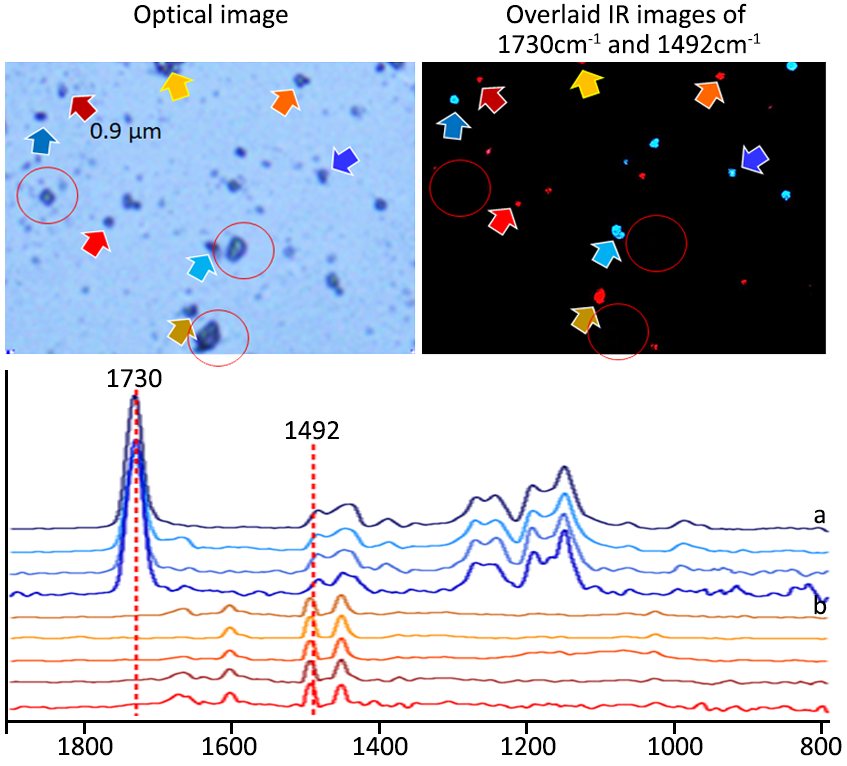
O-PTIR image and spectra of PS and PMMA dispersed in saline
As a demonstration of O-PTIR capability to measure various particle shapes and sizes with artifact-free data collection, mIRage measures PS (0.9 µm, 2.0 µm, 4.5 µm and 10 µm) and PMMA beads (3.0 µm) in salt crystal mixture, shown in high-resolution IR images at key absorption bands.
Distortion free spectra, even amongst salt crystals at hotspots, confirm the identity of the microplastics and readily searched against IR database. Importantly, and unlike traditional FTIR/QCL systems, spectra are consistent, regardless of particle shape or size when measured in reflection mode with no dispersive scatter artefacts.

Simultaneous O-PTIR and Raman spectroscopy
The mIRage platforms ability to measure simultaneous sub-micron O-PTIR and Raman at the same spot and same time, providing significantly higher throughput than measuring with the 2 techniques separately.
The image shows combined spectra (IR+Raman) from a single 500 nm bead and a cluster of 2 µm beads. The spectra are raw and unprocessed and note that the spectra look the same highlighting size independent spectra at small sizes.
Imaging small microplastics in tissue
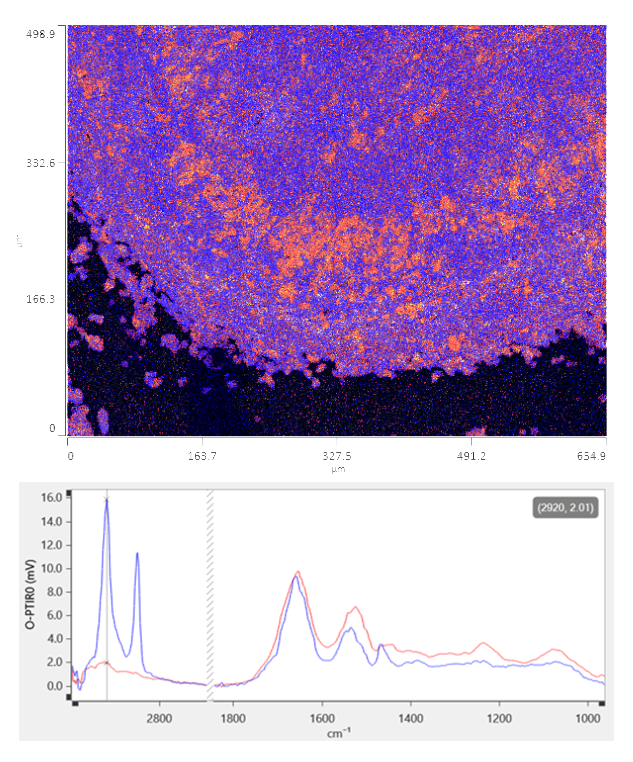
The O-PTIR spectra show a clear differentiation between polyethylene domains and those without. Large C-H stretching (~ 2800-3000 cm-1) and smaller C-H bending modes (~1470 cm-1) are observed and are consistent with spectra shown in published work.
O-PTIR imaging shows the high-resolution distribution of the polyethylene (Red) domains within the tissue section. Additional changes within the tissue are also observed close to the edges, highlighted by the 1080 cm-1 (yellow) distribution in the O-PTIR image.
Faster detection with co-located O-PTIR and Fluorescence microscopy
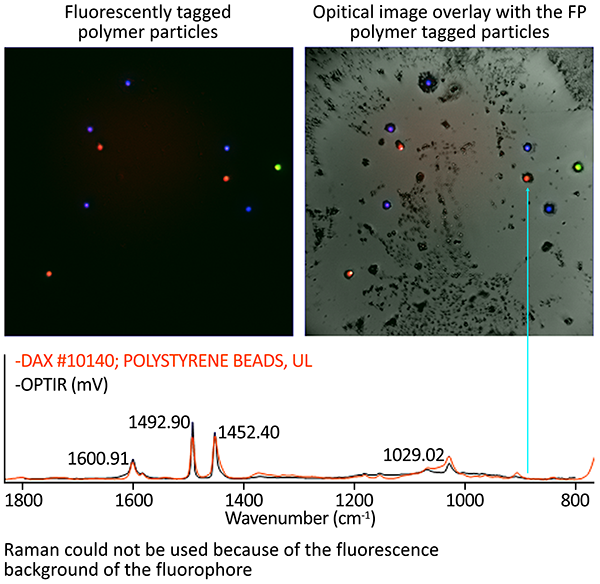
mIRage and mIRage-LS uniquely provide co-located O-PTIR and fluorescence microscopy for faster detection and measurement of organic microplastics.
Fluorescence tagging of polymeric beads can help to isolate the polymer particles from other particles for subsequent high speed spectroscopy measurement with O-PTIR, thus dramatically speeding up microplastics detection and subsequent micro-Chemical ID analysis.
Read our applications note for more information.
Fast accurate microplastics Chemical ID with dual IR/Raman database
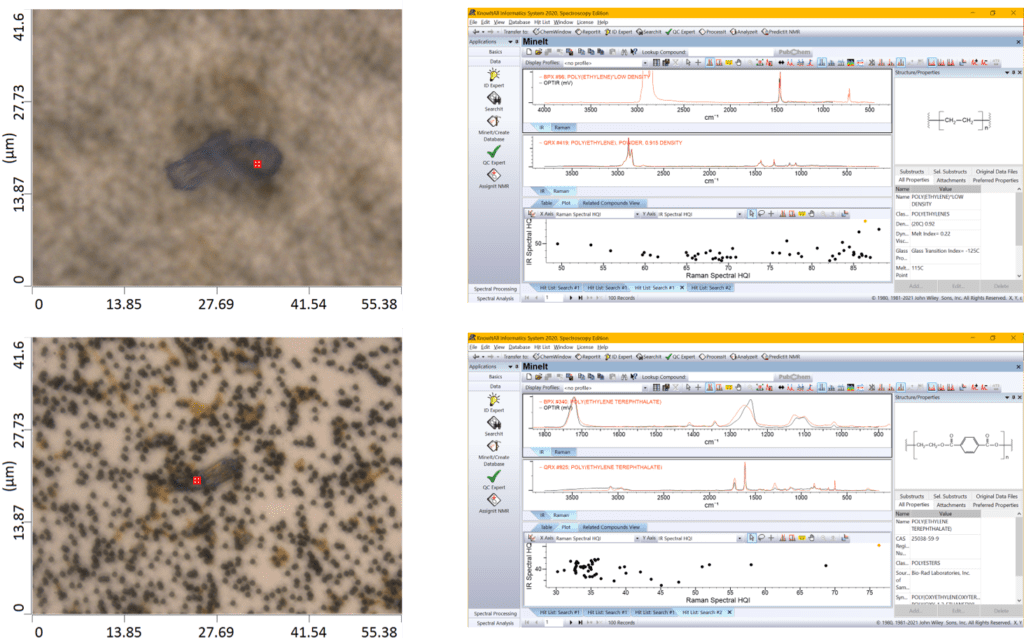
Simultaneous O-PTIR and Raman spectroscopy also provides complementary chemical ID with the KNOWITALL dual IR/Raman database resulting in an optimized HQI value for fast accurate chemical ID.
Top row. Optical image of particle 1, and Wiley KnowItAll dual IR/Raman database search result for O-PTIR/Raman spectra collected on particle 1
Bottom row. Optical image of particle 2 and Wiley KnowItAll dual IR/Raman database search result for O-PTIR/Raman spectra collected on particle 2
Webinar:
Smaller Plastics, Bigger Risks: How submicron IR (O-PTIR) reveals the Invisible threat of Nano- and Microplastics
Application note:
O-PTIR technology for nano- and microplastic detection in tissue: Submicron chemical identification in intact biological systems
Webinars
- Life Science | Microplastics

- May 28, 2026
- Life Science | Microplastics
- April 1, 2026
- Life Science | Microplastics

- March 19, 2026
- Microplastics

- July 23, 2025
- Microplastics
- June 18, 2025
- Life Science | Microplastics

- June 26, 2025
Need more information?
Discover how O-PTIR technology can elevate your research or help solve your toughest challenges. Our team are happy to assist and answer your questions.