
Publication link
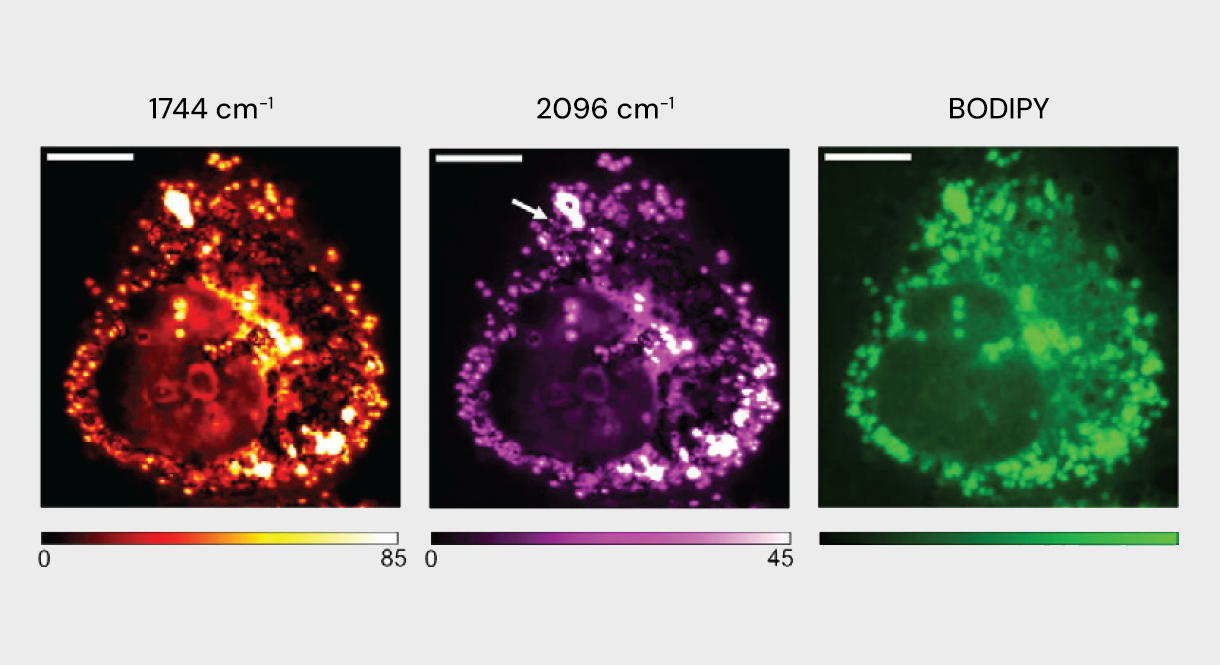
Bai et al. report on addressing the need for advanced techniques for metabolic imaging, particularly in single-cell analysis. The paper discusses the limitations of existing methods and introduces an innovative approach—using an azide-tagged infrared probe. Combining the infrared tag and Optical Photothermal Infrared Spectroscopy (O-PTIR) aims to enhance the understanding of lipid metabolism at the cellular level, which is vital for comprehending various metabolic diseases.
This study presents the development and validation of the combined O-PTIR & IR probe tagging for lipid detection in cells. It highlights the probe’s specificity and efficiency in tagging lipids, which is a significant improvement over traditional methods. The researchers demonstrate the application of this probe in different cell types, highlighting its versatility in detecting subtle changes in lipid metabolism.
These researchers further investigate the application of O-PTIR in complex biological systems. Studies on human-induced pluripotent stem cells (hiPSCs) and their derived microglia provide insights into the dynamic nature of lipid metabolism in these cells. The paper also explores the effects of certain genetic deficiencies on lipid metabolism, offering a deeper understanding of the metabolic alterations in disease conditions.
Furthermore, researchers highlight the unique value of using O-PTIR for this research in comparison to other vibrational spectroscopy techniques. The O-PTIR signal does not suffer from fluorescence background, and—unlike Raman—it can be easily switched between single-wavelength chemical imaging mode and single-point full wavelength spectra. Furthermore, the O-PTIR setups are straightforward and cost effective, not requiring expensive ultrafast lasers.
Bai et al. underscore the significance of this new imaging technique in metabolic research. Their conclusion highlights how these findings can lead to a better understanding of lipid-related metabolic diseases, and potentially inform new therapeutic strategies. The study’s success in providing detailed, cell-type-specific insights into lipid metabolism marks a substantial advancement in the field of metabolic imaging.
Principle Author, Dr. Yeran Bai, et al.
Neuroscience Research Institute
University of California, Santa Barbara
Santa Barbara, CA USA
