
Application note
Submicron infrared microspectroscopy for bitumen–filler analysis
O-PTIR spectroscopy for chemically heterogeneous bitumen systems
Optical Photothermal Infrared (O-PTIR) spectroscopy provides unique capabilities for the analysis of chemically heterogeneous bituminous materials:
- Submicron spatial resolution for infrared chemical characterization, enabling visualization of localized heterogeneity beyond the capabilities of conventional IR microscopy
- Non-contact, far-field measurements suitable for soft, sticky, and irregularly shaped samples with little to no sample preparation
- FTIR transmission/ATR-like spectra, collected in reflection mode
- High-quality infrared spectra from dark and highly absorbing materials using ultra-low probe laser power levels (microwatts)
- Fast single-wavenumber, targeted chemical imaging for visualization of localized compositional variation
Introduction
Bitumen-mineral filler interactions play an important role in determining the rheological, mechanical, and durability properties of asphalt mastics. Mineral fillers influence binder stiffness, adhesion, moisture susceptibility, and long-term pavement performance through both physical and chemical interactions occurring across multiple length scales. Understanding the local distribution of filler components and their interactions with bitumen is therefore important for the optimization of asphalt formulations.
Vibrational spectroscopy techniques are widely used for bitumen characterization. Fourier transform infrared (FTIR) spectroscopy is commonly employed to investigate bitumen chemistry and compositional changes. However, conventional FTIR microscopy is fundamentally limited by diffraction-limited spatial resolution to >10um, restricting its ability to resolve localized chemical heterogeneity at the micron and submicron scale. In addition, FTIR transmission measurements often require thin and uniformly prepared samples, making sample preparation labor-intensive for thick, sticky, or irregularly shaped bituminous materials [1].
Raman spectroscopy offers improved spatial resolution compared with conventional FTIR microscopy and can provide complementary chemical information. However, Raman analysis of dark, highly absorbing bitumen samples is often challenging because high visible laser power may be required to obtain adequate signal intensity. This can result in local heating, fluorescence interference, or even sample damage, particularly in viscous and optically absorbing materials [2,3].
Atomic force microscopy-based infrared techniques (AFM-IR) enable nanoscale chemical characterization and have been applied to bituminous materials [4]. However, AFM-IR measurements require direct mechanical contact between the AFM probe and the sample surface. For soft, viscous, and highly adhesive materials such as bitumen, contact-based measurements can be experimentally challenging and may limit measurement stability, throughput, ease of sample handling and introduce cross-contamination risks.
Optical Photothermal Infrared (O-PTIR) spectroscopy provides an attractive alternative for studying heterogeneous bituminous materials. O-PTIR enables infrared chemical characterization with submicron spatial resolution in a non-contact, far-field measurement geometry while generating FTIR transmission/ATR-like infrared spectra, with reflection mode collection [5]. Because the spatial resolution is governed by the visible probe beam rather than infrared wavelength, O-PTIR can resolve localized chemical heterogeneity at length scales that are 20-30x smaller (better) than conventional FTIR microscopy. In addition, the non-contact reflection measurement configuration is particularly advantageous for dark, sticky, and irregularly shaped bitumen samples that are difficult to analyze using conventional contact-based approaches.
In this application note, O-PTIR spectroscopy was used to investigate chemical heterogeneity in a bitumen–limestone filler system containing 50 wt% bitumen and 50 wt% limestone filler. Submicron infrared imaging and localized spectroscopy were employed to investigate submicron-scale compositional variation within the material.
Optical photothermal infrared spectroscopy
O-PTIR operates using a pump–probe measurement scheme in which a pulsed and tunable mid-infrared laser, typically a Quantum Cascade Laser (QCL), which acts as the pump/IR excitation while a focused visible laser acts as the probe (Figure 1). When the infrared excitation wavelength matches a molecular vibrational mode, localized absorption generates a photothermal response that is detected through modulation of the reflected probe laser signal.
Unlike conventional infrared microscopy, where spatial resolution is governed by the infrared wavelength, the spatial resolution of O-PTIR is determined by the diffraction-limited spot size of the visible probe beam, enabling submicron infrared measurements that are independent of infrared wavelength.
O-PTIR systems can also support simultaneous Raman measurements, however, Raman spectroscopy was not performed in this work. The dark and highly absorbing nature of the bitumen sample made Raman analysis challenging because higher visible laser power, typically required to generate sufficient Raman signal intensity, resulted in sample heating and damage. In order to ensure such dark and highly absorbing samples did not suffer laser damage, an ultra-sensitive, low light level detector, an Avalanche Photodiode (APD) detector configuration was used to enable O-PTIR measurements at reduced visible probe laser power (microwatts) while maintaining high-quality infrared spectra.

Minimal sample preparation and characterization of dark materials
A bitumen–filler sample containing 50 wt% bitumen and 50 wt% limestone filler was investigated using O-PTIR microscopy. The material was measured directly with minimal preparation, where the bitumen-filler was hot poured on a metal piece and analyzed after cooling, taking advantage of the non-contact measurement geometry of O-PTIR. Unlike conventional FTIR imaging, no thin sectioning, ATR contact or specialized sample preparation was required.
Figure 2 shows a photograph of the sample together with the optical image collected on the O-PTIR microscope. The sample exhibited a dark appearance and strong optical absorption, making it susceptible to localized heating under visible laser illumination.
During initial measurements, higher visible laser power levels resulted in sample damage. This challenge was overcome using an ultra-low power avalanche photodiode (APD) detector configuration, which enabled operation at lower probe laser power (microwatts) while maintaining high-signal quality for O-PTIR analysis.

Submicron O-PTIR characterization of localized chemical heterogeneity
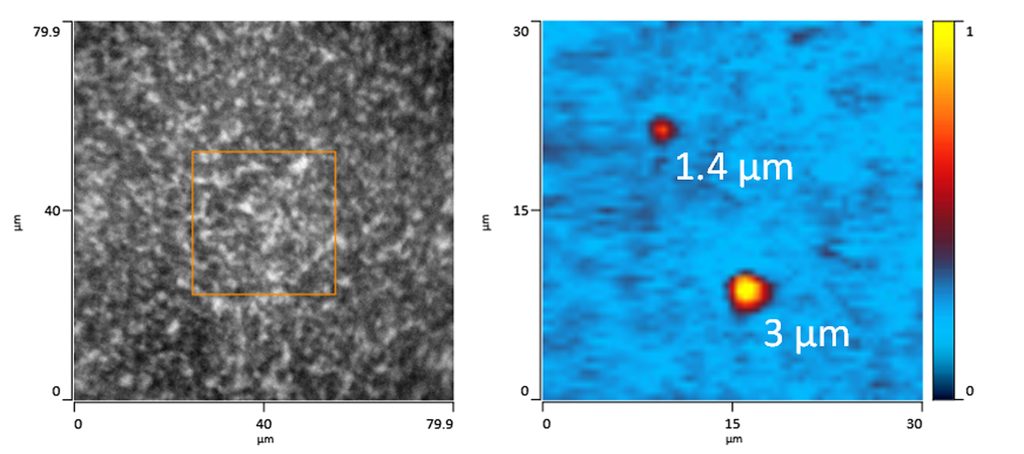
Bitumen–filler systems are chemically heterogeneous materials in which localized variations in composition can influence macroscopic performance. To investigate chemical heterogeneity within the bitumen-limestone filler sample, O-PTIR single-wavenumber imaging was performed using the ratio between 1415 cm–¹ and 1460 cm–¹. Single-wavenumber imaging enables, targeted chemical imaging of only the relevant wavenumbers, corresponding to the chemicals of interest and thus results in a significantly faster chemical imaging, compared to hyperspectral measurements that collect all wavenumbers.
The absorption near 1415 cm–¹ was selected due to its carbonate contribution associated with limestone filler, while the band near 1460 cm–¹ primarily reflects aliphatic hydrocarbon deformation within the bitumen matrix and was used as a reference band.
Figure 3 shows ratioed O-PTIR images revealing localized chemically distinct regions embedded within the surrounding matrix. Two representative regions with approximate dimensions of 1.4 µm and 3 µm were selected for further spectroscopic investigation.
Line-array O-PTIR spectra collected across these regions are shown in Figure 4. The spectra exhibit localized variation in the relative intensity of the carbonate-associated band near 1415-1424 cm–¹ relative to the hydrocarbon-associated band at 1460 cm–¹. These localized regions exhibit increased carbonate-associated signal, consistent with filler-rich regions or bitumen-filler interaction zones.
A carbonyl-associated band near 1712 cm–¹ was also observed in the spectra. While detectable, variation in this feature was limited in the present measurements and was therefore not further interpreted.
These results demonstrate that O-PTIR can resolve localized chemical heterogeneity in highly absorbing bitumen-filler systems at the micron and submicron scale, enabling chemical characterization that is difficult to achieve using conventional infrared microscopy.
Summary
O-PTIR spectroscopy was applied to characterize a dark, viscous bitumen–limestone filler system with minimal sample preparation and non-contact measurement. Conventional vibrational spectroscopic approaches such as FTIR microscopy, Raman spectroscopy, and AFM-IR each present challenges for such materials due to limitations in spatial resolution, sample preparation requirements, laser-induced heating, or the need for physical sample contact.
By combining submicron infrared imaging with localized spectroscopy, O-PTIR enabled visualization of chemically distinct regions exhibiting increased carbonate-associated signal within the bitumen matrix. These regions are consistent with filler-rich domains or localized bitumen–filler interaction zones.
The ability to chemically characterize highly absorbing and sticky materials at the micron and submicron scale highlights the utility of O-PTIR for studying complex bituminous systems and asphalt materials.

Acknowledgement
Photothermal Spectroscopy Corp wishes to acknowledge the support of Dr. Johannes Büchner, Technische Universität Braunschweig, Germany.
References
[1] Primerano, K., Mirwald, J., Lohninger, J., & Hofko, B. (2023). Characterization of long-term aged bitumen with FTIR spectroscopy and multivariate analysis methods. Construction and Building Materials, 409, 133956.
[2] Zhou, Q., Xiao, X., Pan, L., & Tian, H. (2014). The relationship between micro-Raman spectral parameters and reflectance of solid bitumen. International Journal of Coal Geology, 121, 19–25.
[3] Smith, E., & Dent, G. (2019). Modern Raman Spectroscopy: A Practical Approach. Wiley.
[4] Koyun, A. N., Zakel, J., Kayser, S., Stadler, H., Keutsch, F. N. & Grothe, H. (2021). High resolution nanoscale chemical analysis of bitumen surface microstructures. Scientific reports, 11(1), p. 13554.
[5] Prater, C. B., Kansiz, M., & Cheng, J.-X. (2024). A tutorial on optical photothermal infrared (O-PTIR) microscopy. APL Photonics, 9(9).
Webinars
- Life Science | Microplastics

- May 28, 2026
- Life Science | Microplastics

- April 1, 2026
- Life Science | Microplastics

- March 19, 2026
- Life Science
- February 12, 2026
- Life Science

- November 13, 2025
- Life Science

- October 2, 2025
Need more information?
Discover how O-PTIR technology can elevate your research or help solve your toughest challenges. Our team are happy to assist and answer your questions.