
Life Science
High resolution imaging of protein structures
Why O-PTIR for life science research?
The mIRage-LS platform is revolutionizing life science research by uniquely enabling submicron, sub-cellular label-free chemical imaging via the breakthrough technique of multimodal O-PTIR with simultaneous Raman and co-located fluorescence microscopy.
- Highest optical resolution IR spectroscopy achieving <500 nm resolution on biomolecular structures providing unique insights of molecular chemical structures
- Co-located with fluorescence microscopy to quickly identify biomolecular structures of interest and subsequent IR resolution microscopy and spectroscopy
- Investigate a wide range of life science samples, from single bacterial cells, tissues (hard and soft) to eukaryotic cells and their sub-cellular features, in both dried and hydrated states
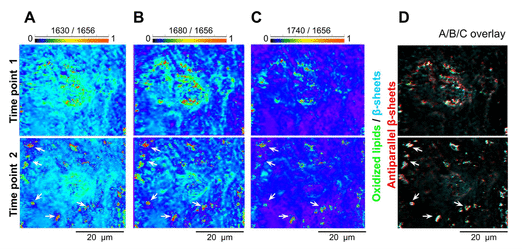
Time-resolved imaging of amyloid structures in living tissue at submicron resolution
(A-C) Single-frequency O-PTIR maps of the same spot in living brain tissue at time 0 and time 10 min.
(A) Change of β-sheet structure distribution over time, calculated as a ratio of 1630 cm–1 (the main β-sheet band) to 1656 cm–1 signal (Amide I maximum). Lower panel, white arrows indicate newly formed β-sheet structures.
(B) Change of distribution of fibrillar β-sheet structures over time, calculated as a ratio of 1680 cm–1 (antiparallel β-sheets) to 1656 cm–1 intensity. Lower panel, white arrows indicate newly formed antiparallel β-sheets.
(C) Change in lipid oxidation over time, calculated as a ratio of 1740 cm–1 (R-CO-OR groups) to 1656 cm–1 intensity. Lower panel, white arrows indicate new spots of lipid oxidation. (D) Overlay of (A-C) single-frequency IR maps, white arrows indicate colocalization of newly formed antiparallel β-sheets and oxidized lipids. The scale bar is the same for (A-D).
J. Am. Chem. Soc. 2023, 145, 45, 24796–24808. Open Access
Protein specific imaging with O-PTIR and co-located Fluorescence microscopy
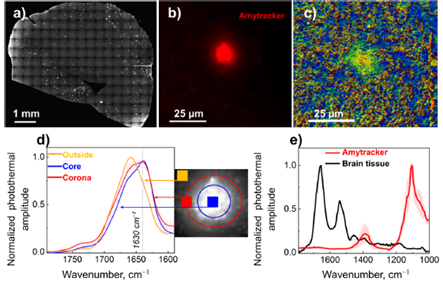
Imaging amyloid plaques in brain tissue by FL-OPTIR.
(a) Fluorescent image of brain tissue with amyloid plaques labeled with Amytracker S20, overview.
(b) Zoom on to the amyloid plaque stained with Amytracker.
(c) O-PTIR Map demonstrating the distribution of β-sheet structures as a ratio of the bands at 1630–1656 cm⁻¹ in the plaque shown in panel (b).
(d) Averaged and normalized FL-OPTIR spectra were recorded from the outside, core, and plaque corona; the spectra locations were indicated by the markers of the corresponding color on the inset.
(e) Comparison of representative IR spectra on brain tissue (black) and Amytracker fluorescent dye (red). Error bars in panels (d) and (e) represent standard deviation.
New Insights into β-Sheet Structures and Carotenoid Associations in Alzheimer’s Disease
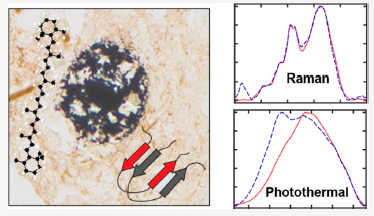
Amyloid β (Aβ) aggregation drives Alzheimer’s disease, yet understanding the chemistry of amyloid plaques remains challenging. This study uses Raman microspectroscopy to identify carotenoids in plaques and reveal their correlation with β-sheet-rich protein structures.
Optical photothermal infrared (O-PTIR) spectroscopy confirms these findings, showing elevated β-sheets in carotenoid-containing plaques but not in noncarotenoid plaques. These results suggest a link between anti-inflammatory carotenoids and specific secondary structural motifs in Aβ plaques, highlighting their potential role in neuroinflammation.
The study provides new insights into chemically distinct plaques and may inform therapeutic strategies for Alzheimer’s disease.
Publication:
Lipid mediated formation of antiparallel aggregates in cerebral amyloid angiopathy
Webinar:
Alzheimer’s Disease Research with Sub-micron Simultaneous IR+Raman: Co-localization of Beta-Sheets and Carotenoids in Aggregates
Publication:
Strain-Distinct α-Synuclein and Tau Cross-Seeding Uncovered by Correlative Approach with Optical Photothermal Infrared SubMicron Imaging
Webinars
- Life Science | Microplastics

- May 28, 2026
- Life Science | Microplastics
- April 1, 2026
- Life Science
- February 12, 2026
- Life Science
- November 13, 2025
- Life Science

- October 2, 2025
- Life Science | Microplastics

- June 26, 2025
Need more information?
Discover how O-PTIR technology can elevate your research or help solve your toughest challenges. Our team are happy to assist and answer your questions.