
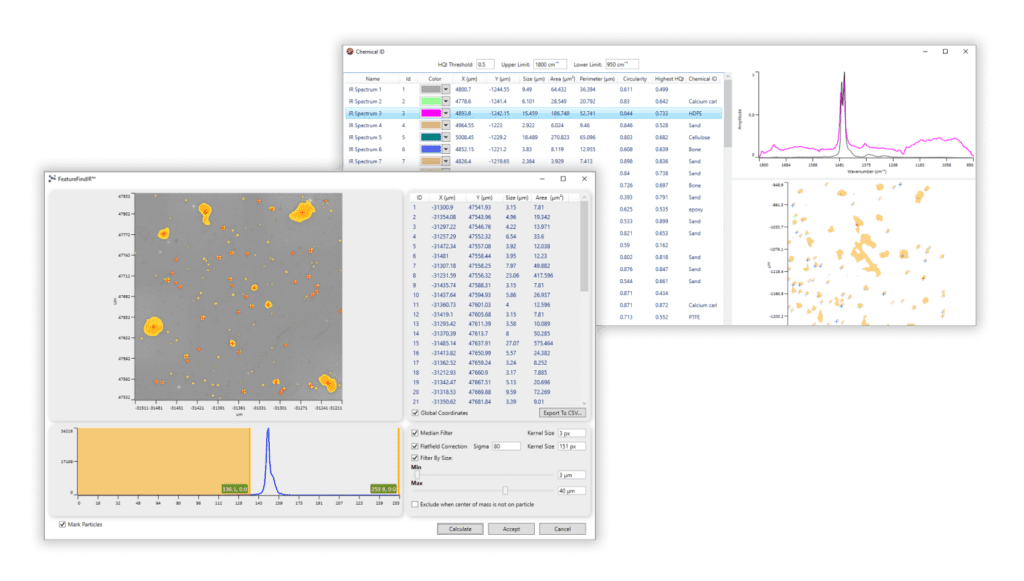
Measures large numbers of particles from sub-micron to mm.
Automated measurement and chemical ID of microplastics
Fast and accurate measurements
About featurefindIR
Many IR and Raman based applications require the measurement of small particles, defects or contaminants, often numbering in the hundreds if not thousands of particles. Most notably, such applications include microplastics identification and the characterization of other particles, such as environmental aerosols, pharmaceutical nasal sprays, and organic contaminants.
Optical Photothermal Infrared spectroscopy (O-PTIR) on the mIRage platforms with featurefindIR accurately and automatically measure and chemically identify particles and micro-plastics from sub-micron to mm’s in size, overcoming the limitations of conventional FTIR and Raman techniques.

Automated, rapid, sub-micron IR and chemical identification of particles and microplastics
Detect, select, measure, identify
The featurefindIR provides rapid, automated detection, spectroscopic measurement, and chemical identification of microplastics and other particles, significantly improving the productivity of measurement and providing a basis for measurements of large number of samples in applications including but not limited to microplastics, defect contamination and cells analysis, as well as many other sample types.
Particle data collection efficiency
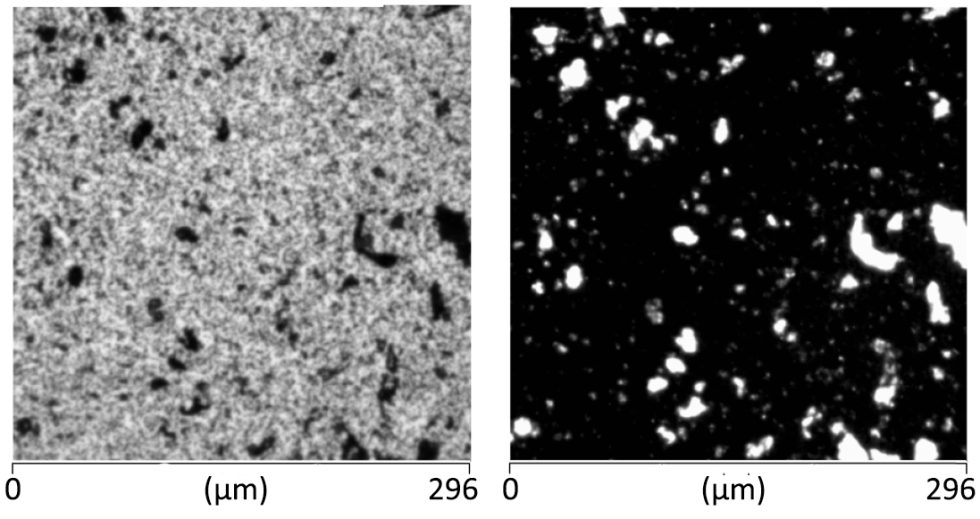
Microplastics, and other contaminants can be difficult to find in a larger population of general materials. featurefindIR supports a variety of image inputs for faster detection of relevant defects:
- The use of a cross polarizer (patent pending) for improved contrast for more sensitive and accurate particle detection and location.
- Fluorescence imaging with the use of stains as input images to help locate the polymeric particles of interest.
- Autofluorescence images provide enhanced optical contrast using the intrinsic fluorescence of the samples, without the need for external dyes.
- Single wavelength imaging at specific wavelengths for fast ID of organic particles in a mix of inorganic material.
Once the image is captured, tools are provided for fast, accurate selection of the desired particles.
Automatically measure and identify
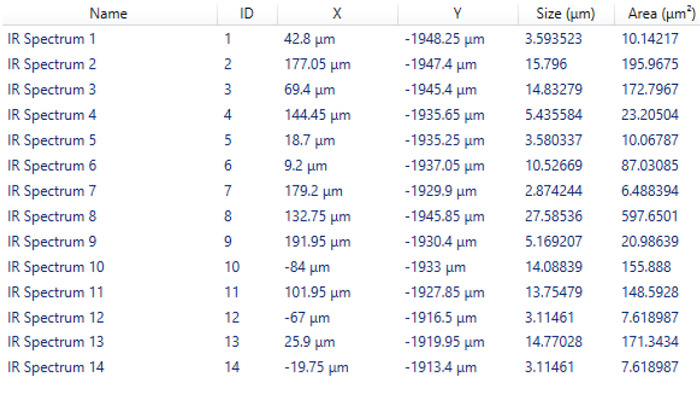
Once particle locations and sizes are determined, the mIRage system automatically moves to all the measurement locations and performs rapid, automated IR spectroscopic measurements.
At completion of the measurement a Particle Info summary table lists the positions and certain dimensions of each particle where a key spectrum was acquired. This table can be transferred to the featurefindIR µChemical ID report or exported as a CSV file for external processing in databases such as KnowItAll® shown here.
Application note:
Submicron IR and Raman spectroscopy for chemical identification of microplastics
Webinar:
New automated submicron microplastics identification with infrared, O-PTIR spectroscopy
Data sheet:
Automated, rapid, sub-micron IR and chemical ID of particles and microplastics
featurefindIR µChemical ID reporting
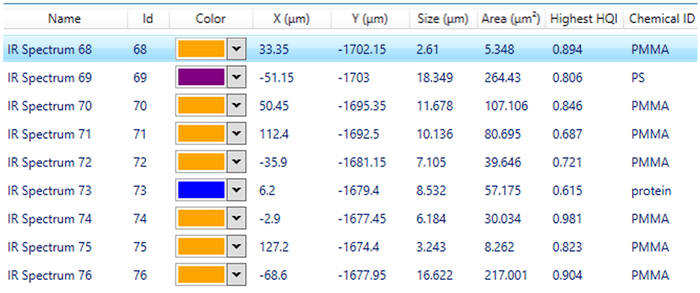
The featurefindIR µChemical ID report automatically analyzes all user selected spectra within a PTIR Studio file and correlates them against a reference set of spectra in an integrated database. A hit quality index (HQI) is reported back for every measured spectrum. If the HQI is above a user set threshold, the best match chemical ID is also reported. An overlay is displayed between the measured and reference spectra. Color coding is available for visual support in assessing the quantity of spectra with specific plastics types being assigned specific colors as a visual aid. Additionally, quantitative checks can be performed by selecting each result to reveal an overlay of detailed spectra with the closest OPTIR reference match.
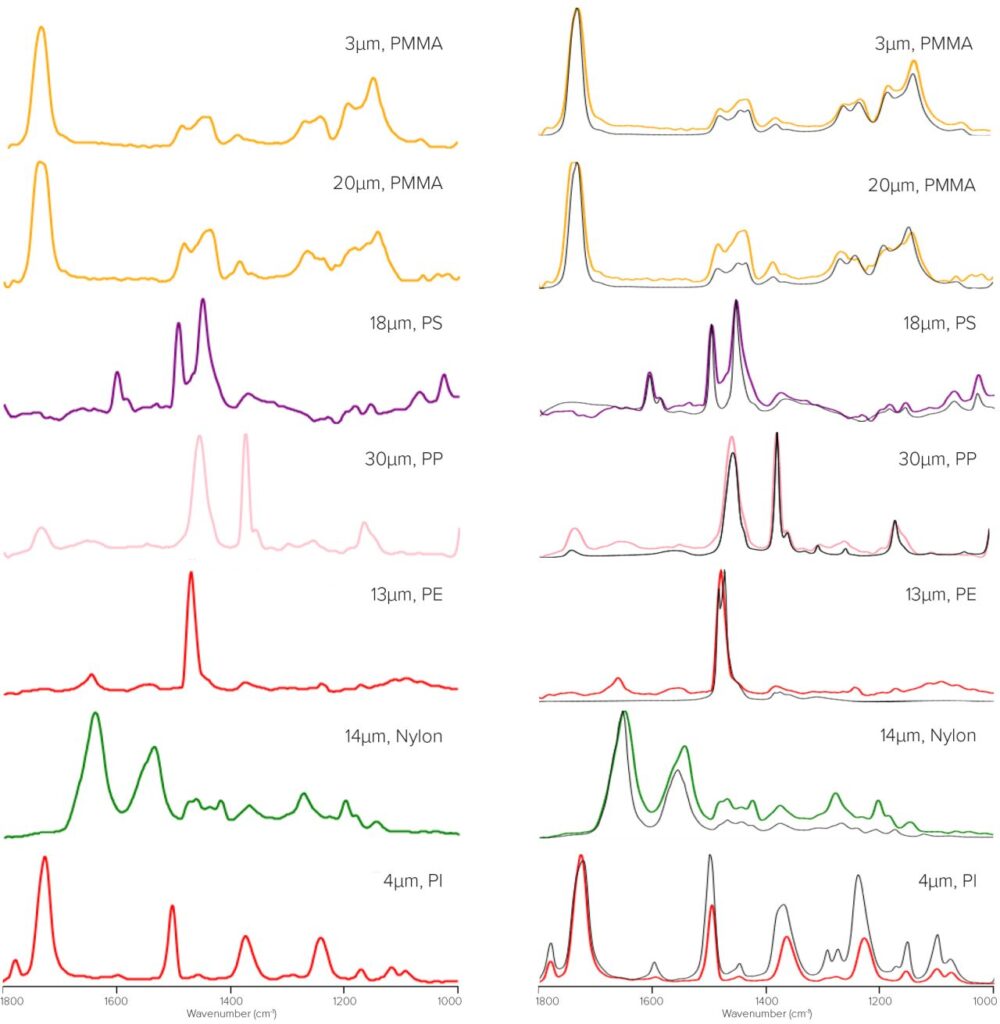
Measurement of small <30µm particles
Representative O-PTIR spectra were collected from a range of different polymer particles covering a range of microplastics sizes. These measurements were focused on the smaller range of microplastics, <30µm that are typically beyond the spatial resolution limits of conventional direct IR microscopes (FTIR or QCL).
The figure shows excellent sensitivity and spectral profiles for all polymer types, even demonstrating the collection of virtually identical spectra from 3µm and 20µm PMMA particles.
A feat that traditional IR cannot achieve, not only because of spatial resolution limits but also due to dispersive scatting artefacts which render such traditional techniques sensitive to artefacts from differences in particle morphology (shape and size).
More products

Sub-500nm Laser Scanning O-PTIR Microscope for High-Speed Imaging. With co-located Fluorescence and Raman spectroscopy.

The mIRage-LS addresses both life science applications and the broad application set of multiuser facilities where the most advanced vibrational spectroscopy needs are required.

Optimized for Value. Same high performance as the mIRage platform but leveraged for dedicated O-PTIR only measurements and a focused range of accessories for application flexibility.
Need more information?
Discover how O-PTIR technology can elevate your research or help solve your toughest challenges. Our team are happy to assist and answer your questions.